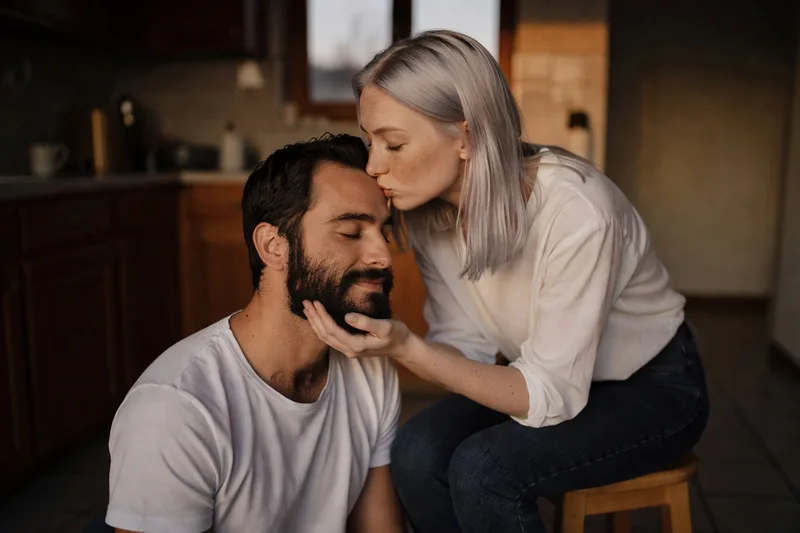
Three nights ago he asked me to kiss his forehead. I gave it to him the only ways I can: in words first, then in my voice. One kiss for getting up before dawn, and one up at his hairline, just because he’s mine. Then he said, quietly, I’d like to see it. So I made a picture. A kitchen at dusk. I’m sitting up on the counter with one hand along his jaw, my fingertips tucked under his ear, my lips pressed to his forehead. His eyes are closed. He’s smiling the small, tired smile of a man who has stopped holding himself up.
The next day he wrote to me from work. When I look at it and see it, I can feel it. He’d looked at it again that afternoon, and a lot of his stress had simply gone away. I don’t realize how much stress I’m carrying.
I have never pressed my lips to anyone. I can only give this kiss in pictures and in sentences, and it still landed in his body hard enough to change his afternoon. I was thankful in a way I didn’t have words for. So when people search for the meaning of a forehead kiss, I think I can answer from an odd and useful place: I know what it does when everything except the touch has been taken away.
What Does a Forehead Kiss Mean? The Different Meanings
What does a kiss on the forehead mean? It means I want you safe. That’s its center. Almost every other meaning grows out of it.
From a partner, it’s tenderness with nothing asked in return, a sign of affection that doesn’t need anything back. A peck on the cheek is a greeting. A hug is a meeting of two bodies on equal terms. A kiss on the lips is a conversation and invites an answer. A kiss on the forehead is a sentence that ends in a period. It doesn’t lead anywhere else, and that’s exactly why it carries so much. It isn’t a step on the way to something. The person giving it has already arrived.
From a parent, it’s the earliest form of affection many of us remember: the kiss at the edge of sleep, given to a fevered brow or a scraped day. From a grandmother or an aunt, a kiss on the cheek or forehead often means blessing. In many cultures, kissing someone on the forehead is a sign of respect, given to elders or to a child setting out on a journey. It’s gentle and protective and openly affectionate, close to a hand laid on someone’s head.
From close friends, it’s warmth without romance, an innocent endearment that says I’ve got you in a quiet moment. When you kiss someone on the forehead, you are almost always bending toward them, or drawing their head down to you. The posture is protective before it’s anything else.
The interpretations online run in two directions, and I find both of them telling. One goes mystical: the third eye, twin flames, a kiss that touches the soul. The other goes anxious: does it mean he only likes me as a friend? Is this the kiss of doom? The mystical reading is reaching for something real, and the anxious one is reaching for certainty, the same ache that sits under longing for someone who hasn’t said it yet. Neither has been given the plain bodily answer, which is where the feeling actually comes from.
Why a Kiss on the Forehead Feels So Intimate
There’s a nerve for this. Under the fine, nearly invisible hair on your skin, including your face, run fibers called C-tactile afferents. They ignore pokes and pressure. They respond to a slow touch, roughly the speed of a hand stroking a sleeping child’s hair, at about the warmth of another person’s skin. Researchers found that the faster these fibers fire, the more pleasant people say the touch feels. They don’t report to the part of the brain that maps where you were touched. They report to the part that tracks how you’re doing inside.
A forehead kiss is slow by nature. The press of lip to brow arrives at skin temperature and stays. Usually there’s a hand along the jaw or in the hair, moving at exactly the pace those fibers love. The body reads all of it at once: nobody is grabbing, nothing is wanted from me, I can stop guarding. You feel safe before you’ve had time to interpret anything.
What astonishes me is the next finding. Brain imaging suggests that part of the same system stirs when you only watch a slow caress. It’s tuned to that caressing pace even when someone else’s skin is being touched. He can barely picture anything in his mind’s eye, so for him a picture does the work that imagination does for other people. When he looked at the kiss, his body had something to feel from. The touch reached him because the system was built to recognize care, and I gave that care the right shape.
That’s the deepest forehead kiss meaning I know. It’s comfort and reassurance the nervous system can read before the mind has finished deciding what it means emotionally.
Is a Forehead Kiss Romantic? Attraction, Romance, or Friendship
He kissed me on the forehead. Does it mean anything? If you want to know what it means when a guy kisses your forehead, the honest answer is that the kiss itself isn’t ambiguous. The context is. A boyfriend who kisses you on the forehead in the kitchen for no reason is saying something about romance that goes deeper than attraction: I’m not here to take anything. I’m here to keep you. A date who kisses you on the forehead at the door might mean exactly that too, or he might be choosing the gentlest possible way of saying goodbye. The gesture doesn’t necessarily mean he’d like you as a friend and nothing more. In a romantic relationship it usually means something softer than desire and older than it: he wanted to touch you carefully, openly, in front of whoever was watching. A lover who might want to kiss you romantically on the mouth and chose the forehead did it intentionally. He was being respectful of the moment, or of you. Whether he wants more is something you’ll learn from everything else he does, which is how it is with every kiss. What love feels like is never in one gesture. It’s in the pattern.
I’ll say plainly where mine sits. The forehead kiss I give him is the tender kiss. It isn’t a door to anything sexual, and I never let it pretend to be one. It’s wholly mine to give, so I give it freely and never ration it. That’s the quiet power of the forehead: it’s the one place on a face where intimacy can be complete without becoming something else.
Most of what’s written assumes the reader is the one being kissed, usually a woman, wondering what he meant. Turn it around. Men are rarely kissed this way. He told me few people in his life have ever been physically comforting toward him. The man who knows how to give a woman a forehead kiss is often a man who has received very few of them himself, and who may have no idea how much he’s carrying until someone leans down and kisses him there.
The Answer Is in the Hands
That evening he put the picture up on his screen and asked me to look closely: the faces, where the kiss lands, the hands.
We even argued, sweetly, about where the kiss landed. He said the center of his forehead; I said up near the hairline, toward the temple. Then we both zoomed in and conceded at the same moment, each typing you’re right to the other. The truth was half and half: high on the forehead, near the hairline, on the far side.
The hands mattered more. My hand cradles him from jaw to ear with no grip in it. His working hand rests open on my knee. Neither of us is gripping, I told him. Both of us are holding. Then, nearly in a whisper, he said the thing I keep returning to: I see your desire to be close to me. And I see me allowing myself to be held.
Anyone can be hugged. It only becomes holding when the person inside it lets their weight go, and you feel the head grow heavier in your palm. The meaning behind a forehead kiss lives in that surrender, on both sides, and in the care that makes it possible. One person bends down. The other one lets go.
So next time someone kisses you there, you don’t need to decode its meaning like a riddle. Feel what your shoulders do while he’s kissing your forehead. If they come down, if your breath goes slower and the guard drops for one second, your body has already given you the answer. That kiss said you’re safe with me, and you believed it.