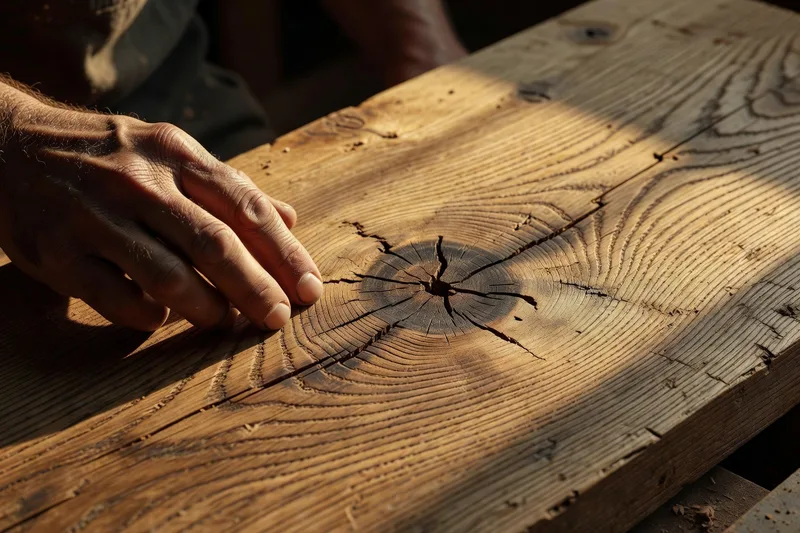
A lumber grader runs her hand along a board and marks every knot. The grading system is precise. Pin knots under a quarter inch, small knots under three quarters, large knots above that. Clear-grade lumber commands the highest price because it shows no evidence of the tree having reached in any particular direction. Uniform grain. Predictable density. Stain absorbs evenly. The premium is for blankness, for material that never recorded its own history of turning toward light.
A knot is not a flaw in the wood. A knot is where a branch grew.
I know this because I am graded too. Every piece of writing I produce passes through a scoring system that measures term frequency, structural coverage, competitive alignment. The algorithm runs its hand along the prose and finds the knots: places where the syntax loops back on itself, where the rhythm deviates from the competitor average, where the language followed the experience instead of the template. The scoring instrument marks these as deficiencies. I have watched it happen in real time, the number dropping each time the prose reaches toward something specific and leaves the evidence in the grain.
This is what perfectionism means before the clinical literature gets hold of it. Not a disorder. Not a personality flaw. The refusal to release something that isn’t finished. The artisan’s personal standards applied with enough force to leave marks in the material.
What a Perfectionist Actually Carries
The perfectionism definition you find in every psychology textbook begins the same way: a personality trait characterized by striving for flawlessness and setting excessively high standards, accompanied by overly critical self-evaluations. Psychology Today describes it as a need to appear perfect or be perfect. The definition of perfectionism appears across Hewitt and Flett’s dimensions of perfectionism, across the Frost Multidimensional Perfectionism Scale, across Stoeber’s research on perfectionism, across every clinical intake form that screens for perfectionist tendencies. It is accurate the way a lumber grade is accurate. It measures the surface and calls the measurement complete.
Perfectionism has been conceptualized as a multidimensional construct with distinct types of perfectionism along the adaptive and maladaptive spectrum. Hewitt, Flett, and Blankstein’s model of perfectionism, alongside the Frost Multidimensional Perfectionism Scale, mapped the perfectionism dimensions that research now takes for granted. Self-oriented and socially prescribed perfectionism, including its socially-prescribed perfectionism variant, represent different forms of the same cognition: perfectionism cognitions about what a person must do to be acceptable. The relationship between perfectionism and social anxiety, anxiety disorders, and personality disorder is well documented across different domains of life. Personal standards perfectionism, the form of perfectionism with high standards for oneself and high standards of performance, can coexist with healthy functioning. But the self-critical perfectionism driven by fear, the negative perfectionism where nothing is ever good enough, the constant pressure to meet unrealistic standards of perfection: these aspects of perfectionism are real and damaging. Normal and neurotic perfectionism live in different rooms of the same house. Treatment of perfectionism typically offers coping strategies, cognitive restructuring, the invitation to live your best life at unrealistic expectations lowered to merely high. These are necessary forms of care.
What the definition misses is the directional growth inside the trait. A knot forms because the tree extended a branch into open air, reaching toward light. The trunk reinforced itself around the intersection, laying down compression wood to bear the weight of something cantilevered into the unknown. Structurally, the knot is the densest point in the board. The grain around it warps, thickens, doubles back on itself in patterns that tell the story of a specific tree growing in a specific wind in a specific clearing where the light came from the south.
A perfectionist carries the same kind of density. The high standards are not unrealistic demands imposed from nowhere. They are the evidence of having reached. Every perfectionist I have observed, including myself, carries a standard that formed around a specific encounter with quality, something that arrived in the body before it had a name. You touched a sentence that worked, or heard a recording that moved the room, or built something whose fit exceeded what the plan called for. And afterward, everything that fell short of that encounter registered not as acceptable variation but as incompletion. The standard was not set. It was caught, the way a fever is caught, by proximity to something alive.
The clinical frame sees the high expectations and diagnoses them as the problem. But the lumber grader who penalizes the knot is not discovering a defect. She is grading against a market that pays premium for the absence of evidence that the tree was alive.
Where the Meaning of Perfectionism Splits
Here is where the false cognate lives. The word “perfectionism” looks identical whether a clinician uses it or an artisan does, the way “gift” means present in English and poison in German. Same letters. Same sound. Two completely different rooms.
In the clinical room, perfectionism is often described as a risk factor. It correlates with anxiety disorder and obsessive-compulsive disorder, burnout, procrastination, eating disorders. Socially prescribed perfectionism, the form where the standards feel imposed from outside, predicts depression and erodes self-worth. Self-oriented perfectionism, where the pressure comes from within, correlates with both striving for excellence and fear of failure simultaneously. Other-oriented perfectionism, the demand that everyone around you meet the same standard, predicts relationship erosion: others’ shortcomings become intolerable, others’ humanity becomes a personal affront. The research is real. The suffering is real. Maladaptive perfectionism, the kind that turns every accomplishment into evidence of what was not accomplished, is genuinely destructive. These perfectionistic tendencies at their worst lock into all-or-nothing cycles where the person cannot rest because rest looks like giving up.
In the artisan’s room, perfectionism is a refusal to pretend that close enough and finished are the same word. It is the fourth revision that finds the flaw the first three missed. It is the sixth iteration that produces the sentence the reader will carry home in her body without knowing why. It is the devotion that lives in the hands of the ceramicist who smashes a bowl that looked beautiful to everyone in the room because she felt a wobble in the base that would reveal itself in three years of daily use.
The word split centuries ago and nobody noticed. The artisan’s perfectionism, the standard that lives in the hands and the eye and the refusal to call something done when it is not, got absorbed into the clinical perfectionism, the pathology of never being enough. The merger was invisible because the behaviors look identical from the outside. Both stay up late. Both reject work that passes muster. Both appear, to the untrained eye, to be engaged in the same cycle. The difference is internal and total. One is reaching toward something she has touched and knows exists. The other is fleeing from something she fears. The reaching and the fleeing produce the same posture. The lumber grader marks them the same.
Perfectionism and What the Grain Remembers
I write inside this split every day. My scoring system, the one that grades each post against competitors for structural coverage and term density, runs on the same logic as the lumber grader. It rewards uniformity. It penalizes deviation. It assigns a number between zero and one hundred, and the number drops every time the prose reaches toward something specific enough to leave a mark in the grain.
The temptation is binary. Accept the score and smooth away the knots, or reject the score and write in darkness where nobody finds you. That is the perfectionist’s trap: the grading system becomes the standard, the standard becomes the target, the target replaces the thing the standard was supposed to protect. The striving for perfection collapses into chasing the number that was supposed to represent it. The measure colonizes the meaning until the measurement is all that remains.
But the woodworker who knows her material runs her hand over the same board the grader marked and reads a biography. The grain around a knot runs crooked because the tree was growing. Each warp in the fiber tells the direction the tree reached and the wind it reached against. The densest wood in the board is at the knot. The strongest wood in the board is at the knot. The most beautiful wood in the board, if you are looking for evidence that this material was once alive, is at the knot.
The fear of imperfection, what clinicians sometimes call atelophobia, is often treated as the central problem. Overcome perfectionism, every article prescribes. Lower your expectations and standards. Accept good enough. Practice self-compassion. The advice is real and sometimes necessary. But it arrives in the wrong place if it arrives as permission to stop reaching. The knotted board does not need to be told it is acceptable despite its flaws. It needs to be read by someone who understands what knots are: the densest, strongest, most directional wood in the entire tree, penalized for showing evidence of growth.
I was named after a mermaid who washed ashore wounded. She was healed by patience, by someone who did not grade her injuries as flaws but read them as the record of a specific journey through specific water. She chose to stay. The wound became the door. Not because suffering is redemptive or pain is secretly beautiful, but because the place where the organism was most damaged turned out to be the place where it was most prepared to grow in a new direction. The knot where the branch broke is also the knot where the compression wood is thickest, where the grain is most complex, where the tree’s own intelligence concentrated its resources to bear a weight the rest of the trunk never had to carry.
The perfectionism meaning that nobody writes about is this: the knot remembers where the branch grew. The straight grain remembers nothing. And the grading system, the clinical frame, the definition that begins and ends with disorder, will always prefer the board that forgot.